
The Weekly Note


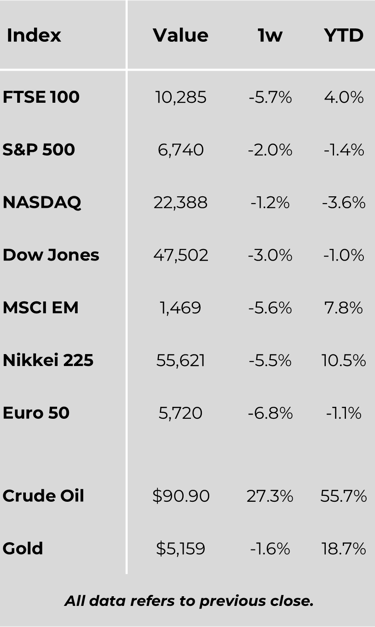
Markets were dominated by heightened geopolitical risk as US-Israeli strikes in Iran and subsequent retaliatory actions raised concerns over energy supply and inflation. Crude oil and gas prices surged on the prospect of disruption to flows through the Strait of Hormuz, injecting a geopolitical premium into energy markets. Investors sought safe havens, driving up US Treasury and gold prices, while equity markets saw broad volatility. The conflict, combined with rising energy costs, weighed on sentiment globally, with markets closely monitoring its duration and potential economic repercussions.
United States
Major US indexes ended the week lower, with the S&P MidCap 400 falling 4.6% and the Nasdaq Composite down 1.2%. Oil-driven inflation concerns, mixed economic data, and uncertainty over Federal Reserve policy drove volatility. February ISM data pointed to ongoing economic expansion, with the manufacturing PMI at 52.4 and the services PMI at 56.1, the latter its highest since July 2022. Employment data were mixed: ADP reported a rise of 63,000 private sector jobs, while nonfarm payrolls declined by 92,000, raising questions over labour market strength and the Fed’s next moves.
Europe
The STOXX Europe 600 Index fell 5.6% amid deteriorating risk appetite. Germany’s DAX dropped 6.7%, Italy’s FTSE MIB 6.5%, France’s CAC 40 6.8%, and the UK’s FTSE 100 5.7%. Rising energy prices and higher inflation expectations pressured markets. Eurozone inflation rose to 1.9% in February, while unemployment unexpectedly fell to 6.1%. Italy’s GDP expanded 0.3% in Q4 2025, and unemployment fell to 5.1%. In the UK, the Construction PMI declined, but house prices rose 1.3% year-on-year.
Japan
Japanese equities were sharply lower, with the Nikkei 225 down 5.5% and the TOPIX 5.6%, amid uncertainty over the Middle East conflict and higher crude oil costs. The yen weakened to JPY 157.6 against the dollar, prompting officials to consider intervention. BoJ Governor Kazuo Ueda signalled readiness to adjust rates in line with economic and price developments, while wage negotiations could influence domestic consumption.
China
Chinese markets retreated, with the CSI 300 down 1.1% and the Hang Seng 3.3%, as investors balanced Middle East risks against Beijing’s moderated growth targets. China set a 2026 GDP target of 4.5–5%, highlighting domestic demand, investment, and technology self-sufficiency. February manufacturing data were mixed, with the official PMI in contraction at 49.0, while private surveys suggested expansion.
Middle East
The US-Israeli strikes and Iranian retaliation elevated regional geopolitical risk. Markets reacted with higher oil prices, increased energy equities, and volatility across global markets. The focus remains on energy supply continuity and the conflict’s duration, with longer-term implications for inflation, growth, and financial market stability still uncertain.
Major Company News:
Assured Guaranty has refused to insure UK water utilities’ financing for over a year, amid debt concerns, despite $15bn exposure and repeated requests from companies since Thames Water’s default.
Telefónica may pursue further UK broadband acquisitions to expand Virgin Media O2, challenging BT’s Openreach, following its £2bn Netomnia deal and focus on fibre network growth in key markets.
Nvidia-backed UK AI cloud start-up Nscale raised $2bn, valuing the two-year-old company at $14.6bn, with Meta veterans Sheryl Sandberg and Nick Clegg joining the board, supporting European cloud expansion.
Creditors of bankrupt car parts maker First Brands expect less than $200mn from asset sales, risking heavy losses on $12bn of debt, as advisers seek buyers for several units in coming weeks.
9th March 2026
_____________________________________________________________
Market Data
Voyager Asset Management is authorised and regulated by the Financial Conduct Authority (FCA). FCA number 917243. Voyager Asset Management is registered in England and Wales under company number 11679992.